
Quick Summary
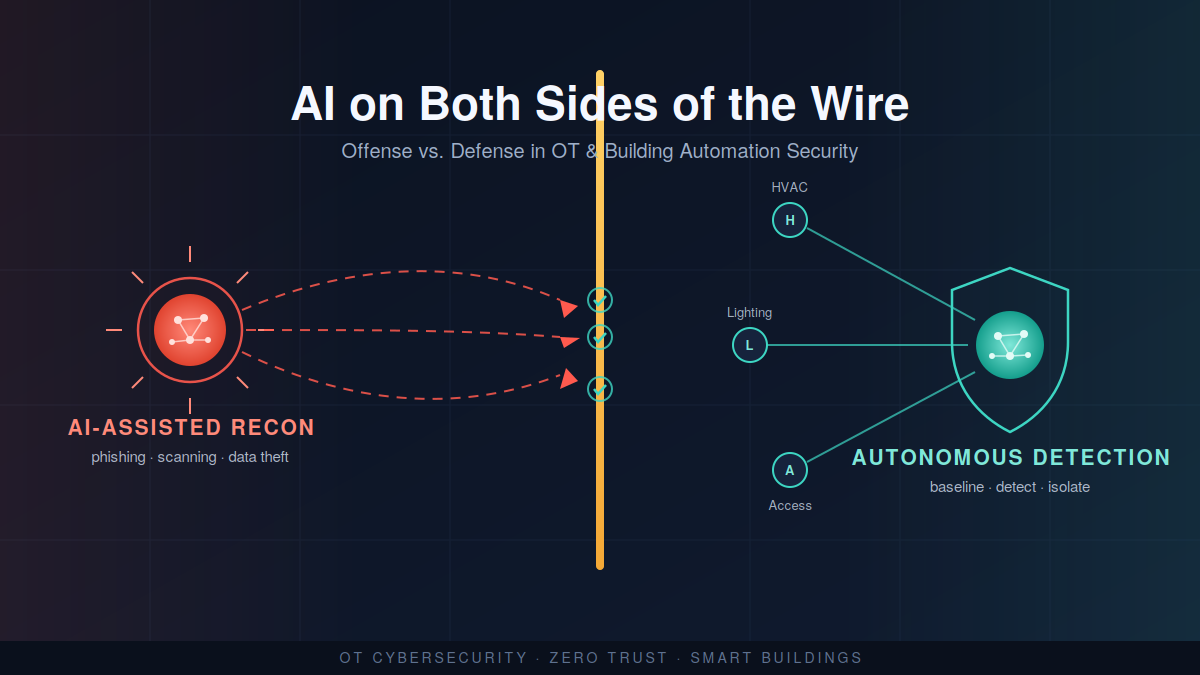
Artificial intelligence has arrived on both ends of the OT attack chain. Adversaries are using generative AI to accelerate reconnaissance, craft convincing phishing lures aimed at facility operators, and probe legacy building automation systems for weaknesses at machine speed. At the same time, defenders are deploying autonomous detection tools that baseline normal controller behavior and flag, or even isolate, anomalies faster than any human analyst could. For OT engineers and integrators, the takeaway is clear: the fundamentals (segmentation, asset visibility, least-privilege access) matter more than ever, because AI amplifies whichever side has the better foundation.
For most of the history of building automation, obscurity was a kind of armor. An attacker who wanted to do real damage to a BAS needed to understand BACnet, know their way around a specific controller family, and invest serious time mapping a target. That learning curve filtered out all but the most motivated adversaries.
Generative AI just flattened that curve.
The Offense: Recon at Machine Speed
Today’s attackers are using large language models the same way your junior techs do, to get up to speed fast on unfamiliar systems. Ask the wrong model the right questions, and the protocol quirks, default credentials, and common misconfigurations of legacy building controllers stop being tribal knowledge and become a query away.
The more immediate threat, though, is reconnaissance and social engineering. AI can scrape a building portfolio’s public footprint, job postings that name the BMS platform, integrator case studies, LinkedIn profiles of facility staff, and assemble a target package in minutes. It can then generate phishing emails that reference the actual chiller plant service contract, addressed to the actual operations manager, written in flawless, context-aware language. The clumsy tells that once gave phishing away are gone.
There’s a subtler risk, too: attackers are increasingly interested in stealing operational data itself, trend logs, sequences of operations, network captures, because that data can train better attack tooling. In OT, your data exhaust is now an asset worth protecting.
None of this requires a nation-state budget. That’s the real shift. AI hasn’t invented new attack techniques so much as it has made existing ones cheap, fast, and scalable, which means smaller commercial buildings that once flew under the radar are now economically viable targets.
The Defense: Autonomy Where Humans Can’t Keep Up
Here’s the good news: OT environments are, in one important way, easier to defend with AI than IT environments. Building systems are creatures of habit. A VAV controller talks to the same supervisory device, on the same ports, in the same rhythm, day after day. That predictability is a gift to anomaly detection.
Modern AI-driven monitoring platforms baseline this normal behavior across thousands of points and flag deviations a human would never catch in a sea of telemetry, a controller suddenly polling devices it has never spoken to, a firmware checksum that changed outside a maintenance window, a vendor VPN session at 3 a.m. on a Sunday. The emerging generation of “agentic” tools goes a step further, executing pre-approved responses automatically: quarantining a device, cutting a remote session, or alerting the on-call tech before an attacker can pivot toward critical control loops.
For engineers and integrators, the caution flag is obvious. Autonomous response in an environment that runs life safety and comfort systems demands guardrails. Nobody wants an algorithm isolating an AHU controller during a heat wave over a false positive. The practical pattern emerging in the field is tiered autonomy: full automation for low-consequence actions like killing an idle vendor session, human-in-the-loop approval for anything that touches equipment operation.
Another consideration is the implementation of a zero-trust layer, especially for legacy/existing equipment, where updating this capability in the device firmware is not an option. Zero trust security will automatically reject all communication to a protected device.
What This Means for Your Practice
The uncomfortable truth is that AI rewards whoever has the stronger fundamentals. Detection models are only as good as the visibility beneath them, you can’t baseline assets you haven’t inventoried. Autonomous containment only works if the network is segmented well enough that isolation is even possible. And AI-generated phishing only succeeds against organizations without phishing-resistant MFA and verification procedures for access requests.
That means the guidance in frameworks like IEC 62443 and CISA’s recent zero trust publications for OT isn’t outdated by AI, it’s prerequisite to it. Zones and conduits, least-privilege remote access, continuous asset inventory: these are the substrate that makes AI defense effective and AI offense harder.
Integrators who internalize this have a genuine differentiator. The firms that can walk into a project and speak fluently about both the sequence of operations *and* the security architecture will own the next decade of smart building work. The ones that treat security as someone else’s scope will find themselves competing on price alone, or explaining, after an incident, why the network they installed had no baseline to defend.
AI is on both sides of the wire now. Which side it favors in your buildings is still up to you.
Key Takeaways
- AI has lowered the barrier to attacking OT. Reconnaissance, protocol knowledge, and convincing phishing that once took weeks of expert effort can now be generated in minutes, putting smaller building portfolios in the crosshairs.
- Facility operators are the new phishing target. AI-crafted lures referencing real vendors, contracts, and staff defeat the “spot the typo” training of the past, phishing-resistant MFA and out-of-band verification are essential.
- OT predictability is a defensive advantage. Building systems’ repetitive traffic patterns make AI-based anomaly detection unusually effective compared to noisy IT environments.
- Use tiered autonomy, not full autopilot. Automate low-consequence responses (killing idle sessions); keep humans in the loop for anything that can affect equipment operation or life safety.
- Fundamentals are the force multiplier. Segmentation, asset inventory, and least-privilege access per IEC 62443 and CISA’s OT zero trust guidance determine whether AI helps you more than it helps your attacker.
- Security fluency is a competitive edge for integrators. Firms that pair controls expertise with security architecture will win the projects, and keep the clients, of the AI era.