
Quick Summary
10BASE-T1L is transforming building automation by extending Ethernet and IP connectivity all the way to the field device over a single twisted pair—enabling smarter, more data-driven buildings without costly rewiring. But this expanded connectivity also increases cyber exposure at the very edge of the network. This article explores how 10BASE-T1L changes the BAS threat landscape and why device-level Zero Trust security, like Veridify’s DOME™ platform, is essential to unlock its benefits without expanding the attack surface.
Introduction: A Breakthrough for Building Connectivity
Building automation systems (BAS) have historically relied on segmented, non-IP field networks such as BACnet MS/TP, LonWorks, or proprietary serial protocols. While limited in bandwidth and flexibility, these architectures provided a form of “security by obscurity” through isolation.
10BASE-T1L fundamentally changes that model. By delivering long-reach Ethernet (up to 1,000 meters) over a single pair of wires—and often over existing cabling—it allows IP connectivity to reach HVAC controllers, lighting systems, meters, and sensors directly. This accelerates IT/OT convergence, simplifies architectures, and supports advanced analytics, cloud integrations, and digital twins.
However, every new Ethernet connection is also a new cyber doorway. Without proper security controls, 10BASE-T1L risks exposing the most critical and least protected devices in a building.
Why 10BASE-T1L Expands the Attack Surface
Unlike traditional BAS field networks, 10BASE-T1L brings Ethernet to devices that were never designed with cybersecurity in mind. Many field controllers and sensors:
- Lack native encryption or authentication
- Use static addressing and predictable communication patterns
- Remain deployed for 15–30 years with limited patching
Once these devices are IP-enabled, attackers no longer need to breach a central server or management workstation. Compromising a single exposed device can allow:
- Device impersonation and spoofing
- Unauthorized command injection
- Lateral movement across BAS and OT systems
- Disruption of physical operations (comfort, safety, energy, and access control)
In other words, 10BASE-T1L increases visibility and reachability—but not security—unless additional protections are added.
Why Traditional Network Defenses Fall Short
Many organizations attempt to secure new Ethernet BAS deployments using familiar IT tools such as firewalls, VLANs, or network segmentation. While useful, these controls were designed for north-south traffic and trusted internal devices—not highly distributed OT endpoints.
In 10BASE-T1L environments, this approach breaks down because:
- Field devices communicate east-west, often bypassing centralized inspection points
- Trust is assumed once inside the network, enabling attackers to blend in
- Legacy devices cannot run endpoint security agents
- Segmentation increases complexity and is often relaxed over time for operational convenience
As a result, buildings gain connectivity but inherit IT-style cyber risks without IT-grade defenses at the device level.
Zero Trust at the Edge: Securing 10BASE-T1L the Right Way
To expand connectivity without expanding risk, security must move down to the device itself. A Zero Trust model—where no device or message is trusted by default—is essential for 10BASE-T1L deployments.
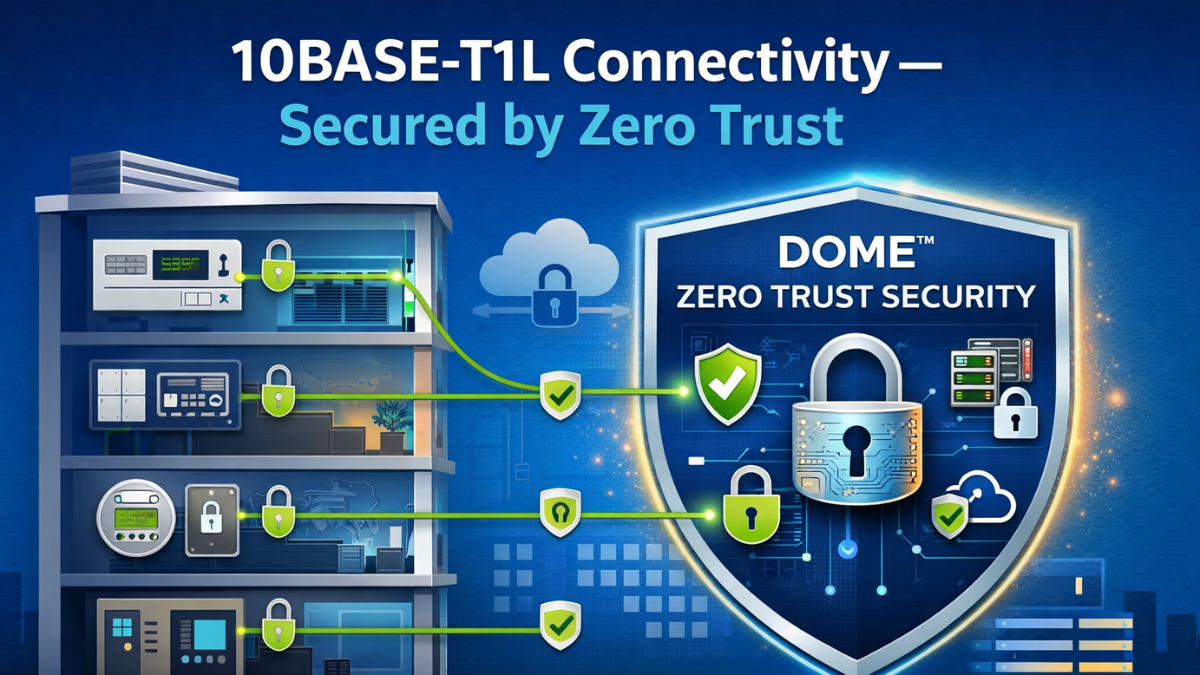
Veridify’s DOME™ Zero Trust platform is purpose-built for this challenge. Rather than relying on network location or protocol assumptions, DOME secures BAS communications by:
- Establishing cryptographic device identity for each controller, sensor, or gateway
- Enforcing mutual authentication so devices must prove who they are before communicating
- Encrypting all traffic in real time, preventing eavesdropping and tampering
- Protecting legacy and modern devices alike without firmware changes or rip-and-replace
- Operating inside the firewall, stopping attacks that bypass perimeter defenses
With DOME, 10BASE-T1L becomes an enabler—not a liability—by ensuring that every Ethernet connection is cryptographically verified and continuously protected.
Operational Benefits Beyond Cybersecurity
Securing 10BASE-T1L at the device level also delivers operational advantages for building owners and operators:
- Faster adoption of IP-based field devices without redesigning networks
- Reduced risk of downtime, tenant impact, and safety incidents
- Improved compliance with frameworks like NIST CSF 2.0 and Zero Trust Architecture guidance
- Future-ready protection for long-lived BAS assets, including post-quantum cryptography readiness
In effect, Zero Trust security becomes the foundation that allows digital transformation to scale safely across the building lifecycle.
Conclusion: Connectivity and Security Must Advance Together
10BASE-T1L is a major step forward for smart buildings, enabling richer data, simplified architectures, and broader innovation. But without device-level Zero Trust protection, it also widens the cyber attack surface into the heart of building operations.
By pairing 10BASE-T1L with Veridify’s DOME™ platform, building owners can confidently modernize their BAS infrastructure—expanding connectivity while shrinking risk, and ensuring that every device is trusted, authenticated, and protected.
Key Takeaways
- 10BASE-T1L extends Ethernet and IP directly to BAS field devices, increasing visibility and flexibility
- IP-enabling legacy devices also increases cyber exposure if security is not addressed
- Traditional perimeter and segmentation-based defenses are insufficient for 10BASE-T1L networks
- Zero Trust, device-level security is essential to prevent spoofing, lateral movement, and disruption
- Veridify’s DOME™ platform enables secure 10BASE-T1L adoption without network changes or device replacement

Table of Contents
- Quick Summary
- Introduction: A Breakthrough for Building Connectivity
- Why 10BASE-T1L Expands the Attack Surface
- Why Traditional Network Defenses Fall Short
- Zero Trust at the Edge: Securing 10BASE-T1L the Right Way
- Operational Benefits Beyond Cybersecurity
- Conclusion: Connectivity and Security Must Advance Together
- Key Takeaways
