
Quick Summary
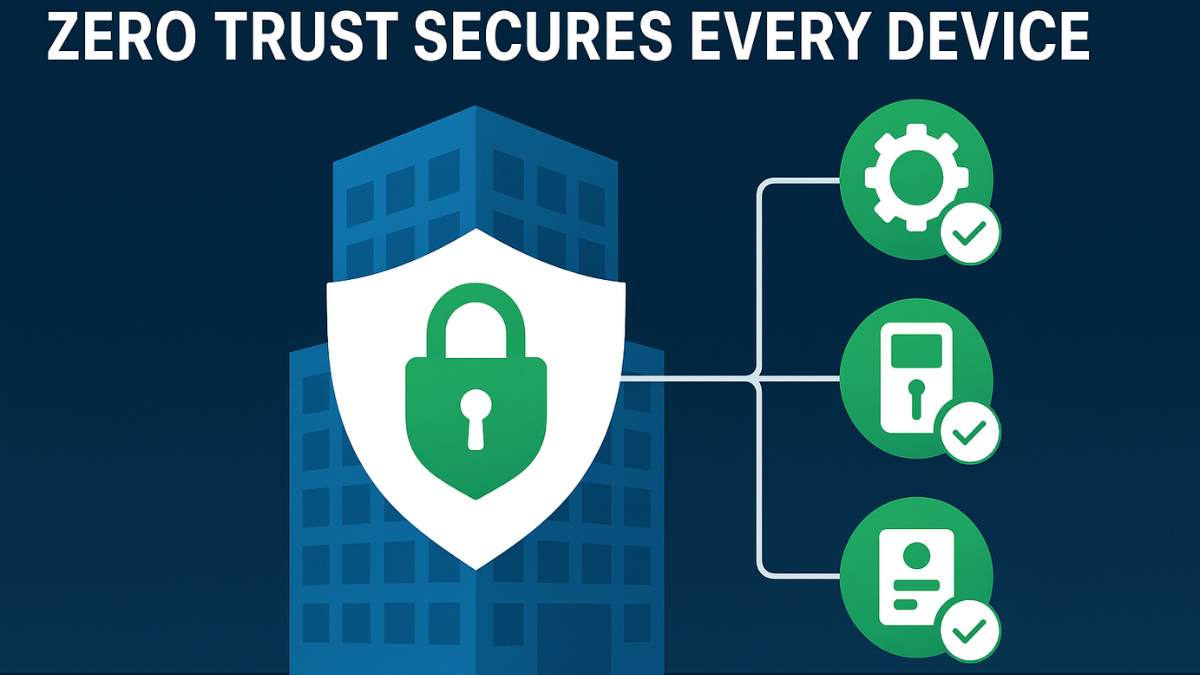
Zero Trust brings continuous verification to the edge of your smart building—every device, command, and data flow. With OT attacks rising and many BAS communications still lacking strong auth and encryption, Zero Trust controls (device identity, mutual authentication, encryption, micro-segmentation, and continuous monitoring) directly reduce downtime, blast radius, and breach costs—while aligning to NIST SP 800-207 and CISA ZTMM guidance.
Introduction
Smart buildings now run on thousands of connected devices—controllers, sensors, actuators, badge readers—speaking legacy protocols and cloud APIs. This connectivity delivers incredible efficiency, but it also dissolves the “safe interior” that traditional perimeter defenses assumed. Zero Trust flips that model: never trust, always verify, for every device, user, and data flow. NIST formalized this approach in SP 800-207, describing Zero Trust as a shift from static network perimeters to continuous verification of assets and resources. (NIST Publications)
Why Zero Trust is now a BAS requirement
- Threats are moving into OT/BAS. Ransomware and malware aimed at industrial and building environments continue to rise, with researchers tracking significant year-over-year growth in attacks impacting OT operations. (Industrial Cyber)
- Plaintext, unauthenticated device traffic is still common. Many IoT/OT communications lack encryption and strong authentication, leaving data and commands open to interception or manipulation. Various industry studies continue to highlight large proportions of unencrypted device traffic and weak controls in connected environments. (ScienceDirect)
- Operational impact can be severe and costly. IBM’s 2024 report places the average breach cost at USD 4.88M globally (higher in several sectors), underscoring why preventing lateral movement inside the building network matters. (IBM)
- Removable media and remote services magnify risk. Honeywell’s 2024/2025 research shows USB-borne threats and ransomware campaigns increasingly designed to disrupt industrial operations, not just steal data. (Honeywell)
Regulators and guidance bodies now embed Zero Trust into modernization roadmaps. The CISA Zero Trust Maturity Model gives agencies and operators a practical path to move from “traditional” to advanced, identity- and asset-centric protections across networks, devices, and data. (CISA)
What “Zero Trust for BAS” actually means
Zero Trust is not a single product—it’s an operational design pattern you apply across devices, identities, networks, applications, and data. In building automation environments, that maps to:
- Strong, device-level identity
Give every BAS device (controllers, sensors, actuators, gateways) a unique cryptographic identity. This enables mutual authentication before any command or telemetry is accepted. (Aligned to NIST SP 800-207’s emphasis on continuous identity verification.) - Least-privilege access and policy enforcement
Implement role-based, context-aware policies for operators, vendors, and services. Commands get allowed only if the device identity, requester role, and context match policy. (Mapped to CISA ZTMM pillars for identity, devices, and network segmentation/micro-segmentation.) - Encrypt data in motion across legacy protocols
Even when you keep BACnet/Modbus/KNX in place, encapsulate traffic in authenticated, encrypted tunnels to block eavesdropping or command tampering—closing a major gap in many BAS. (Supports the “data” pillar in Zero Trust.) - Micro-segment BAS networks
Prevent flat networks where a single compromised workstation or vendor portal becomes a freeway to every device. Place granular policy boundaries between floors, systems, and device groups. (Reinforced by CISA ZTMM and related micro-segmentation guidance.) - Continuous verification and monitoring
Verify every request, every time. Stream device identity, integrity, and policy decisions to your SIEM/OT monitoring to detect spoofing, replay, and anomalous behavior early. (Matches NIST ZTA guidance around ongoing evaluation.)
NOTE – The above capabilities are provided by Veridfy’s DOME platform.
The evidence: why Zero Trust reduces BAS risk
- Fewer high-impact operational events. Many vulnerabilities with deep process impact reside inside the ICS/BAS network; preventing unauthorized lateral movement and unverified commands (core Zero Trust outcomes) limits loss-of-view/control scenarios.
- Lower breach costs when containment is faster. IBM’s data shows cost curves closely track detection and containment time. Identity-anchored, policy-enforced communications reduce blast radius and speed triage.
- Blocking common ingress paths. Honeywell’s research found over half of malware samples in 2024 were designed to propagate via removable media, and 82% had potential to disrupt operations—reinforcing the need to verify endpoints and restrict what devices can talk to what, and when.
A pragmatic Zero Trust roadmap for facility teams
- Baseline your assets and trust relationships. Inventory controllers, field devices, vendor remote paths, and service accounts. (CISA ZTMM “visibility & analytics”.)
- Start with device identity on critical systems. Provision cryptographic IDs to BMS servers, gateways, and high-impact controllers first; enable mutual authentication.
- Encrypt legacy protocol flows. Add authenticated encryption wrappers/tunnels for BACnet/Modbus segments—no forklift upgrade required.
- Apply micro-segmentation and least privilege. Separate network zones by system and function; enforce policy at boundaries.
- Integrate with monitoring and incident response. Stream policy decisions and device posture to your SIEM/OT analytics for continuous verification.
- Harden removable media and vendor access. Enforce signed media, device control, and just-in-time privileges for third parties.
Where a Zero Trust platform fits
A device-centric Zero Trust platform (e.g., one that issues per-device cryptographic identities, enforces mutual authentication + encryption on every transaction, and blocks unauthorized commands/firmware) operationalizes the above without replacing your existing BAS devices. This is the fastest path to close protocol gaps while aligning with NIST SP 800-207 and CISA ZTMM guardrails.
The platform that enables this for building automation systems and smarts is Veridify’s DOME platform (see 4-min demo).
Key Takeaways
- Perimeter alone is not enough: attackers increasingly target OT/BAS and move laterally once inside.
- Zero Trust = verify everything: strong device identity, least-privilege policy, and encrypted communications.
- Operational resilience: limiting unverified commands and deep-network exposure reduces loss-of-control events.
- Cost impact: faster containment and smaller blast radius correlate with lower breach costs.
- Deployment ready: Veridify’s DOME platform provides a practical zero trust solution that can be deployed in BAS by existing technicians.