
Quick Summary
A cyber breach in building automation can inflict far greater damage than lost data. Beyond IT, BAS attacks can bring down HVAC, disable access control, spike utility costs, disrupt tenant operations, and tarnish reputation. Real-world data shows that breaches cost millions — and when smart buildings are involved, that number can skyrocket.
Introduction
When people talk about cybersecurity cost, the focus is often on stolen data, regulatory fines, or remediation. But when a cyberattack hits a Building Automation System (BAS), the fallout goes far deeper. A BAS breach can disrupt critical infrastructure: shutting down HVAC in a hospital, locking tenants out of offices, spiking energy bills, and eroding occupant confidence. The ripple effects often exceed what happens in traditional IT incidents.
In this article, we quantify the operational, financial, and reputational costs of BAS cyber incidents, draw on real-world statistics, and highlight why building operators must treat BAS cybersecurity as a core risk area, not an optional add-on.
Real-World Cost Benchmarks & Data
- According to IBM’s Cost of a Data Breach report, the average cost of a data breach globally in 2024 was USD 4.88 million. (CMIT Solutions)
- In the industrial sector, the average breach cost rises by 13% above the global average, reaching about USD 5.56 million. (IBM)
- The CISA Cost of a Cyber Incident study identifies that the time to detect and respond, lost business, emergency fixes, and cascading downtime often represent the largest share of incident cost. (CISA)
- In construction and infrastructure, cyberattacks have already led to losses. For example, the Interserve breach reportedly cost over £11 million (~USD 14 million) in remediation and damages. (ScienceDirect)
These figures apply broadly across sectors. When a breach affects a BAS controlling dozens or hundreds of devices across a building, the cost factors may multiply.
Components of Cost in a BAS Cyber Incident
Below is a breakdown of cost categories and how they often manifest in BAS attacks:
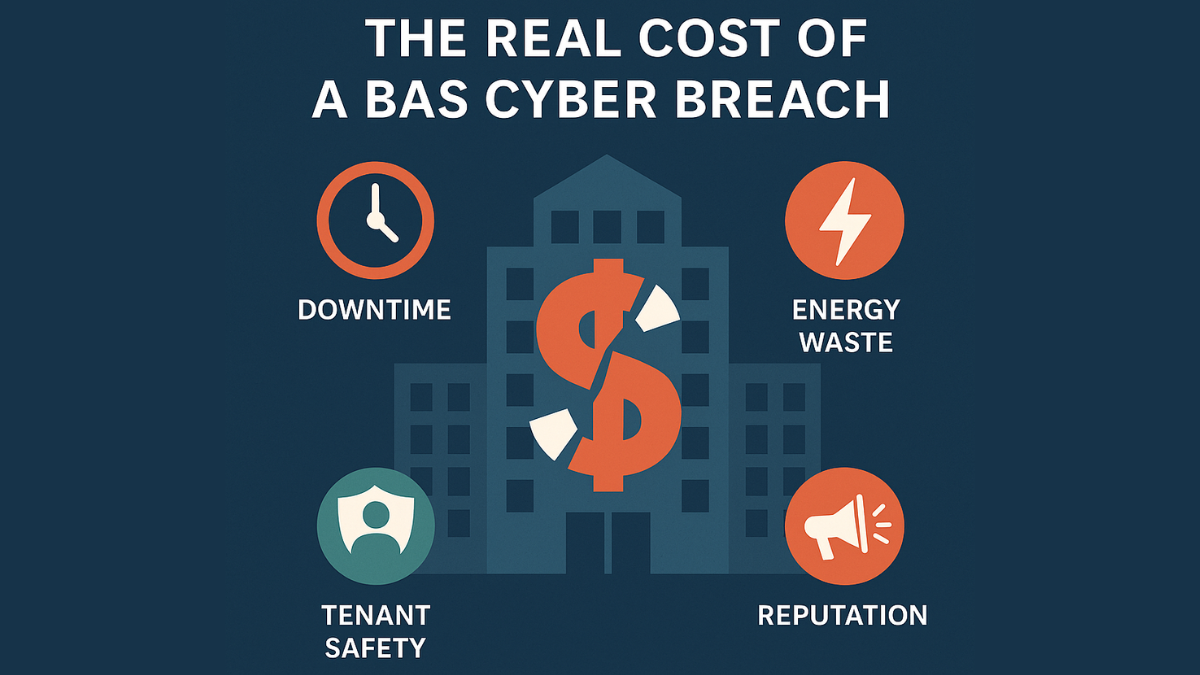
- Downtime / Operational Disruption
When HVAC, lighting, access control, or elevators malfunction, operations stall. A hospital ICU could be forced to evacuate or limit patient intake; offices may be uninhabitable; commercial tenants may lose revenue. Downtime can cost thousands to tens of thousands per hour, depending on facility type.
- Energy Waste & Inefficiency
Manipulated schedules, setpoints, or device misconfigurations can send systems into overdrive, heating or cooling when no one is present, venting air, or running equipment 24/7. The resulting energy overconsumption can lead to dramatic spikes in utility bills.
- Tenant Safety & Liability
If systems controlling access, fire suppression, gas detection, doors, or elevators are compromised, occupant safety is at risk. A malicious actor could unlock doors, disable alarms, or misconfigure environmental conditions. Liability exposure increases significantly if an incident leads to physical harm.
- Reputation & Trust Damage
Tenants, clients, or hospital patients expect safety, reliability, and privacy. A publicly exposed BAS security failure undermines trust. Organizations may suffer long-term reputational damage, customer attrition, and difficulty winning future deals.
- Incident Response & Recovery
Costs here include forensic investigation, legal and consulting fees, system repairs, overtime staff, vendor engagements, and sometimes ransom payments. For BAS, specialized OT forensic work is more expensive than generic IT forensics.
- Regulatory & Insurance Penalties
Depending on jurisdiction, breaches involving critical infrastructure may incur fines or mandatory reporting costs. Some cyber insurance policies (especially for BAS/BMS) include deductibles, sub-limits, or exclusions that amplify losses. (Veridify)
Scenario Example (Hypothetical)
Imagine a mid-size office building using BAS for HVAC, lighting, and door control. An attacker compromises the BAS and manipulates HVAC schedules while disabling access control temporarily:
- Downtime / disruption: $20,000
- Energy overuse (over 24 hr): $5,000
- Tenant productivity loss / complaints: $10,000
- Investigation & recovery: $30,000
- Reputational / tenant compensation: $15,000
Total: ~$80,000+ for just one day of disruption. For large or critical facilities (hospitals, labs, data centers), this scale may be 10× to 100× higher.
Why BAS Breaches Often Outpace IT Breaches
- Scale & scope: BAS attacks affect physical systems, safety, and occupancy, not just data.
- Longer lifecycles: OT assets like HVAC controllers have long lifespans, making patching and replacement harder.
- Hidden failures: Many incidents are misattributed to mechanical faults rather than cyber root cause, delaying detection.
- Trust gaps: BAS networks often sit outside core security monitoring, giving attackers a stealth path.
Mitigation and Risk Reduction
To reduce exposure and cost, building operators should:
- Adopt device-level Zero Trust to authenticate and encrypt every endpoint interaction.
- Integrate BAS with security monitoring (SIEM, OT/IT convergence) to detect anomalies swiftly.
- Apply segmentation and micro-segmentation around BAS networks.
- Partner with insurance that understands BAS risk, ensuring policy terms cover operational and safety losses.
- Maintain incident response plans specific to OT environments — conduct drills before a breach.
Key Takeaways
- BAS breaches carry multi-dimensional costs: downtime, energy waste, safety, reputation, and recovery.
- The average breach cost in industrial / infrastructure contexts often surpasses USD 5 million. (IBM)
- BAS systems may make attacks more damaging due to their control over physical infrastructure.
- Many incidents go undetected or misattributed to mechanical failure, increasing response time and cost.
- Mitigation must include device-level Zero Trust, integrated monitoring, and segmentation.